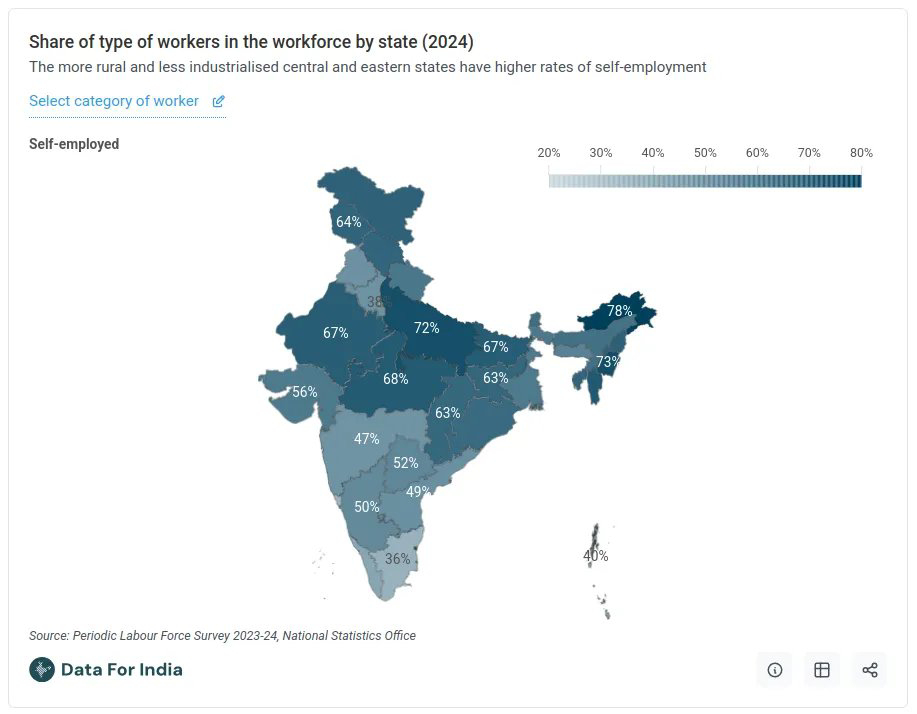
Only 6% of India's self-employed actually hire other workers

India's official data shows 60% of workers are "self-employed" - but this statistic hides a crucial reality. Only 6% of these individuals actually employ others. For most, self-employment isn't entrepreneurship but a last resort when better jobs aren't available.

Only 6% of India's self-employed actually hire other workers. The remaining 94% either work solo or help family members without pay—often in marginal operations just to survive.

The income gap tells the real story: self-employed workers earn about ₹13,200 monthly compared to ₹20,700 for salaried employees. That's ₹7,000 less every month or 50% higher earnings for those with regular jobs.

Regional patterns further reveal that self-employment isn't driven by entrepreneurial spirit. It's highest in India's least industrialized states like Uttar Pradesh (75% self-employed) and lower in industrialized states like Tamil Nadu (33%).

Comments

Popular posts from this blog

Unveiling the "Real Majority" of India

Unveiling the "Real Majority": Divya Dwivedi’s Critique of the Hindu Majority Narrative * In contemporary Indian discourse, the notion of a "Hindu majority" is often taken as an unassailable fact, with official statistics frequently citing approximately 80% of India’s population as Hindu. This framing shapes political campaigns, cultural narratives, and even national identity. However, philosopher and professor at IIT Delhi, Divya Dwivedi, challenges this narrative in her provocative and incisive work, arguing that the "Hindu majority" is a constructed myth that obscures the true social composition of India. For Dwivedi, the "real majority" comprises the lower-caste communities—historically marginalized and oppressed under the caste system—who form the numerical and social backbone of the nation. Her critique, developed in collaboration with philosopher Shaj Mohan, offers a radical rethinking of Indian society, exposing the mechanisms of power t...

Mallanna Unleashes TRP: A New Dawn for Marginalized Voices in Telangana's Power Game

On September 17, 2025, Chintapandu Naveen Kumar, popularly known as Teenmar Mallanna—a prominent Telugu journalist, YouTuber, and former Congress MLC—launched the Telangana Rajyadhikara Party (TRP) in Hyderabad at the Taj Krishna Hotel. The event, attended by Backward Classes (BC) intellectuals, former bureaucrats, and community leaders, marked a significant moment for marginalized groups in Telangana. Mallanna, suspended from Congress in March 2025 for anti-party activities (including criticizing and burning the state's caste survey report), positioned TRP as a dedicated platform for BCs, Scheduled Castes (SCs), Scheduled Tribes (STs), minorities, and the economically weaker sections. The party's vision emphasizes "Samajika Telangana" (a socially just Telangana) free from fear, hunger, corruption, and prejudice, with a focus on inclusive development and responsible governance. Key highlights from the launch: Symbolism : The date coincided with Periyar Jayanti and V...

జనగణనలో కుల గణన: పారదర్శకత ఎలా?

T.Chiranjeevulu, IAS Ret కేంద్ర ప్రభుత్వం 2025 ఏప్రిల్ 30న జనగణనలో కుల గణన చేపట్టాలని తీసుకున్న నిర్ణయం భారతదేశంలో సామాజిక న్యాయం కోసం ఒక చారిత్రక అడుగు. ఇది ఓబీసీల చిరకాల డిమాండ్‌ను నెరవేర్చడమే కాక, వెనుకబడిన కులాలకు న్యాయం అందించే దిశగా కొత్త అధ్యాయాన్ని సృష్టిస్తుంది. అయితే, ఈ కుల గణన పారదర్శకంగా, విశ్వసనీయంగా జరగాలంటే కొన్ని కీలక అంశాలను పరిగణనలోకి తీసుకోవాలి. ఈ వ్యాసంలో పారదర్శకత, విశ్వసనీయత కోసం అవసరమైన సూచనలను చర్చిస్తాం. కుల గణన యొక్క ప్రాముఖ్యత భారతదేశంలో కులం ఒక సామాజిక వాస్తవికత. ఇది వివక్ష, అణచివేతలకు కారణమవుతుంది. కుల గణన ద్వారా సామాజిక, ఆర్థిక వెనుకబాటుతనాన్ని గుర్తించి, సమస్యలకు పరిష్కారాలు చూపే అవకాశం ఉంది. ఇది ఓబీసీ రిజర్వేషన్ల సమీక్ష, ఉప-వర్గీకరణ, మానవ అభివృద్ధి సూచికల మెరుగుదలకు దోహదపడుతుంది. పారదర్శకత కోసం సూచనలు కుల గణన విజయవంతంగా, నమ్మకంగా జరగాలంటే కింది సూచనలు పాటించాలి: సెన్సస్ డిపార్ట్‌మెంట్ ఆధ్వర్యంలో నిర్వహణ కుల గణన సెన్సస్ డిపార్ట్‌మెంట్ ఆధ్వర్యంలో జరగాలి, ఎందుకంటే ఈ విభాగంలో శిక్షణ పొందిన అధికారులు, అనుభవం, పర్యవేక్షణ నైపుణ్యం ఉంటాయి. గతంలో (2011) గ్రామీణ, ...